Zoo
Project

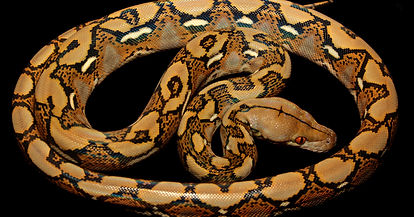
Python reticulatus
Reticulated Python
Domain: Eukaryota Kingdom: Animalia
Phylum:Chordata
Class: Reptilia
Order: Squamata
Family: Pythonidae
Genus: Python
Species: reticulatus
Taxonomy
Biome
Characteristics/Adaptations
-
The size of the python is a threat to almost any organism and also allows it to consume its large prey.
-
A python bites its prey quickly and then pulls it into its grasp quickly. By entangling its prey, it coils itself around the prey and begins to constrict around it. This will usually cause the animal to lose breath before any bones break.
-
The coloration and skin patterns on a reticulated python allow it to blend in with its environment and remain hidden.
-
It has the ability to unhinge its jaw and consume its prey whole. A python also has stretchable skin which allows it to compensate for consuming large prey.
Rainforest
Oxygen & Carbon Dioxide Exchange
Snakes have a small opening behind their tongue called the glottis which then opens into the windpipe. The glottis is always closed unless the snake takes a breath. While the snake eats, it expels the glottis outside of its mouth which allows it to breath. These snakes breathe by contracting muscles between their ribs. Oxygen is drawn into the windpipe where it meets the par of the lung nearest the snake’s head. Oxygen exchange occurs here and carbon dioxide is expelled. The oxygen is then brought to the hear t where it is distributed throughout the body.
Circulation and Excretion
Pythons have a three-chambered heart that is composed of two atria (receive blood) and a large ventricle (pumps blood). Unlike mammals, reptiles have a renal portal system. Blood from the tail passes through the kidneys first before returning to the general body circulation.
After the kidneys remove waste products, the materials are transfer to the cloaca where it is expelled from the python’s body.
Nutrients
Pythons obtain nutrients by consuming their prey (often whole) through their mouths. After killing their prey (usually by suffocation), the python will then take advantage of the entire body and eat the whole organism completely whole. They don’t have meals very often so they must be able to cope with fasting by re-feeding on large meals and intense digestion and nutrient absorption. Pythons have a cell type that has the ability to break down bones in their gut contents. These specialized cells break down the particles before releasing the nutritional chemicals into the bloodstream.

Resources
Picture: http://www.reptilesmagazine.com/Care-Sheets/Snakes/Reticulated-Python/
Info: http://animaldiversity.org/accounts/Python_reticulatus/
http://bioweb.uwlax.edu/bio203/s2008/young_timo/adaptation.html
http://news.softpedia.com/news/How-do-Pythons-Digest-Their-Prey-to-the-Bone-51248.shtml
http://www.reptilesmagazine.com/Kid-Corner/Beyond-Beginners/Snake-Anatomy-Respiratory/
http://www.reptilesmagazine.com/Kid-Corner/Beyond-Beginners/Snake-Anatomy-Cardiovascular/
http://www.peteducation.com/article.cfm?c=17+1831&aid=2974
http://reptilis.net/serpentes/senses.html
Phylogenetic Tree: http://www.reptile-database.org/db-info/snakes.html
Reception and Response
Because snakes spend a lot of time on the ground, they do not need, nor have, a good sense of sight. Second, their sense of hearing is quite acute. They lack external ears but do have inner ears that allow them to hear low frequency airborne vibrations. However, they hear more through their jaw. Ground vibrations travel through the python’s body until it reaches the middle ear bone and then is sent to the inner ear. Their sense of touch is also highly developed and allows them to sense the slightest changes in their environment. When a stimulus reaches the snake, the python has the ability to make quick changes in muscular movement during movements since the receptors are sensitive to the slightest shifts in the ground. The python also has the ability to sense the heat of other creatures. Snakes are able to sense changes in temperature through pits that are located in the lips. This aids the predator at night because it can automatically know where its prey is in relation to itself and doesn’t necessarily have to see it.
However, the snake’s strongest sense is its combined sense of smell and taste. They have adapted their tongues and nostrils to be able to capture scent particles in the air and can transform this stimulus into olfactory information. The vomeronasal organ allows a snake to do this.
Phylogenetic Tree
