Zoo
Project


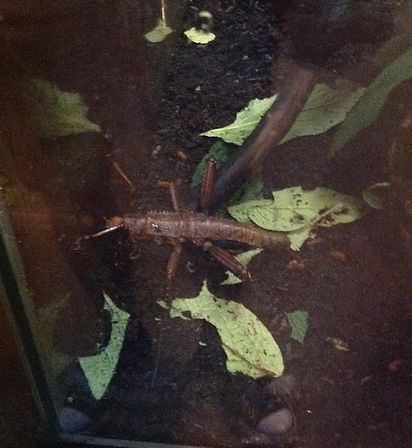
Eurycantha calcarata
Thorny Devil
Domain: Eukaryota Kingdom: Animalia
Phylum: Arthropoda
Class: Insecta
Order: Phasmatodea
Family: Phasmatidae
Genus: Eurycantha
Species: calcarata
Taxonomy
Biome
Rainforest
Characteristics/Adaptations
-
This insect is nocturnal, meaning that it moves about at night to feed on plants.
-
They have strong mandibles so that they can easily chew vegetation.
-
Their bodies are heavily armored with sharp spines. These spines extend the entire length of the insect’s body and can be used in situations where it feels threatened. It will raise its abdomen and use its hind legs to snap down and pinch onto a potential threat. The spines extending the length of the body also make it very undesirable to eat.
-
The thorny insect also has the ability to excrete a foul odor, especially in males. The exocrine glands behind its head emit this strong odor.
-
During the day, a group of individuals will form to hide under bark and in hollows of logs. The insects are very well camouflaged. They take on the appearance of a stick in order to trick predators into believing that the insect isn’t there. Also, the entire cluster will pretend like they’re dead in order to trick predators as well.
Oxygen & Carbon Dioxide Exchange
The insect circulates air throughout its body by means of a tracheal system. A network of air tubes carries oxygen directly to tissues within the body. Oxygen enters these tubes through spiracles and is then moved through the system by diffusion or contraction of air sacs. Blood is not involved at all in the exchange of oxygen.
Circulation and Excretion
The insect has an open circulatory system. This means that blood flows freely within body cavities and has the ability to make direct contact with all internal tissues and organs. The dorsal vessel is the major component of the insect’s circulatory system and is called the heart. It is divided into chambers that are separated by valves to ensure that hemolymph (similar to blood but 90% plasma) travels in one direction. Alary muscles force the hemolymph from chamber to chamber. The fluid then circulates back to the head by a tube called the aorta.
The Thorny Devil, like most birds, filters out liquid waste in the blood via the kidneys. They then convert this urine to uric acid because it is much less toxic than ammonia. This product can then be excreted as a semisolid which allows the insect to retain more water for internal processes.
Nutrients
This insect is a herbivore that scavenges for its food (ficus, bramble, raspberry, rose, and guava).The Thorny Devil has a complete digestive system which means that digestion takes place in a tube-like enclosure. This is called the alimentary canal, and runs the length of the body. It is divided into three functional regions: foregut, midgut, and hindgut. The foregut deals with food digestion while the midgut deals with nutrient absorption itself. Waste excretion is then limited to the hindgut. This insect not only has this canal, but also has salivalry glands and reservoirs. Movements in the mouth help mix saliva with food in the buccal cavity. This causes food to immediately begin to break down as it enters the insect’s body.
Resources
Picture: http://abctoppictures.net/spiny+devil+walking+stick
Info: http://www.torontozoo.com/explorethezoo/AnimalDetails.asp?pg=508
http://www.ncsu.edu/project/bio402_315/Lecture%20two/arthropod%2011.html
http://www.cals.ncsu.edu/course/ent425/tutorial/digest.html
http://www.cals.ncsu.edu/course/ent425/tutorial/senses.html
Phylogenetic Tree: http://www.pnas.org/content/104/2/565/F4.expansion.html
Reception and Response
This insect has three major sensory receptors that aid them in their environment. The first, mechanoreceptors, detects movements or vibrations throughout its environment. The second, chemoreceptors, detect chemical substances in the air (smell) or on substrates (taste). The last, photoreceptors, detect the presence and quality of light. All three of these receptors help the thorny devil obtain nutrients and detect danger.
If a thorny feels that it is threatened, it will raise it abdomen above itself to try to intimidate its predator. Males also have the advantage of having sharp spines on their hind legs that they can use in self-defense. The insect can also emit a foul-smelling substance through their legs in order to disgust the predator. However, none of these can be activated without the insect’s receptive ability of its environment.
Phylogenetic Tree
